Short answer
Pandan is the long green leaf of a tropical screwpine plant, used in Southeast Asian cooking for its sweet, grassy, vanilla-like aroma and natural green color. It flavors desserts, cakes, rice and drinks.
Pandan is the long, narrow green leaf of a tropical plant called Pandanus amaryllifolius, a type of screwpine, and it is used across Southeast Asia to give sweet and savory dishes a fragrant, grassy, vanilla-like aroma and a natural green color. It flavors Filipino buko pandan, Malaysian and Indonesian cakes, Thai desserts, steamed rice and drinks. This guide explains what pandan is, how it smells and tastes, which forms are sold, how it is used, what can replace it, and whether it appears on the menu of Nanding’s Bakery in Honolulu.
What is pandan?
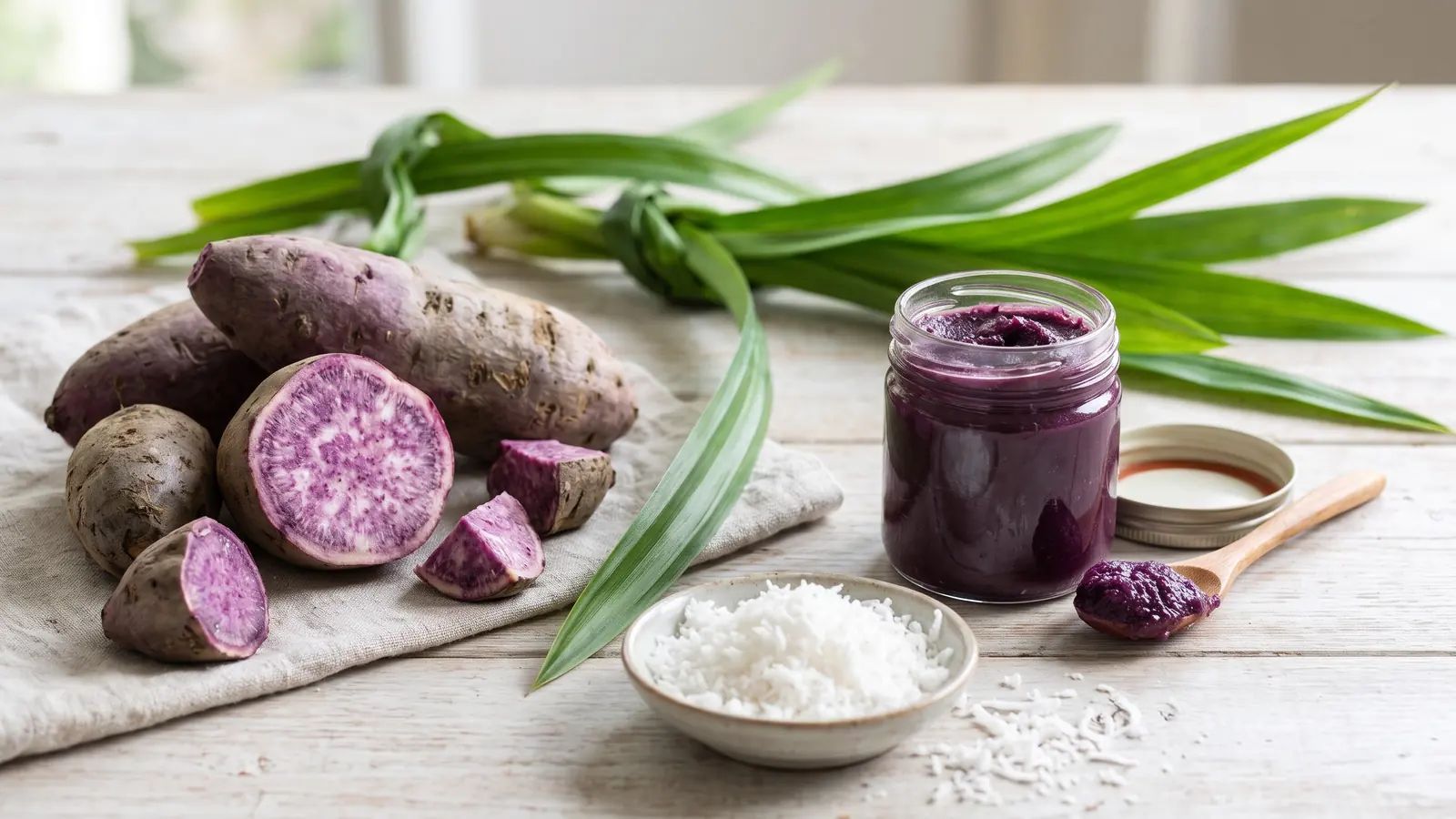
Pandan is a tropical plant whose long, blade-like leaves are used as a flavoring in Southeast Asian cooking. The plant is a relative of the screwpines, and it grows in warm, humid climates. The species used in cooking is Pandanus amaryllifolius, and the leaves are bright green and flat, often folded or knotted to fit in a pot.
The leaves are not eaten whole. They are tough and fibrous, so cooks either tie them in a knot and simmer them in a liquid, wrap food in them, or blend and strain them to extract the juice. The juice gives desserts a pale green color.
The plant is sometimes called the vanilla of Southeast Asia, because of its sweet aroma, but that comparison is loose. Pandan has its own character, and it is a different plant entirely.
What does pandan taste and smell like?
Pandan smells sweet, grassy and floral, with a soft hint of vanilla and coconut. The taste is mild and delicate, and it is more about aroma than flavor. When it is cooked in rice, coconut milk or custard, it gives a warm, fragrant note that many people recognize immediately.
Descriptions vary. Some people compare the smell to freshly cut grass mixed with vanilla, and others compare it to a nutty, popcorn-like aroma. These are subjective descriptions, and two people may describe it differently.
Because the flavor is gentle, pandan works well with coconut milk, sugar, rice and eggs. It is less common with strong or acidic flavors, where it can be hard to notice.
Is pandan green naturally?
Pandan leaves are naturally green, and the juice extracted from them is a pale green. The deep, bright green seen in many pandan desserts is often boosted with food coloring. A bakery cake that is bright green may contain pandan flavor, food coloring or both.
This matters because a green color is not proof of real pandan. A product made with only green food coloring will not have the same aroma. Reading the ingredient list or asking the baker is the best way to know.
Natural pandan color fades with heat and light, so baked goods made with real pandan may turn a softer green or slightly olive after baking.
What forms of pandan are sold?
Pandan is sold as fresh leaves, frozen leaves, extract, paste and powder. Each has a different strength and use, and the choice depends on the recipe.
| Form | What it is | Best for |
|---|---|---|
| Fresh leaves | Whole leaves, sold in bundles | Infusing rice, coconut milk, custards, drinks |
| Frozen leaves | Whole or cut leaves, frozen | Same uses as fresh, often easier to find |
| Pandan juice | Leaves blended with water and strained | Coloring and flavoring cakes, jellies, desserts |
| Extract | Concentrated flavoring, often with green color | Quick flavor and color in baking and desserts |
| Paste | Thick concentrate | Cakes, fillings, doughs |
| Powder | Dried, ground leaf | Doughs, drinks, dry mixes |
Extract and paste are convenient, but quality varies, and some brands rely on artificial flavor and color. Fresh and frozen leaves give the most natural aroma, but they take more work.
How is pandan used in cooking?
Pandan is used to flavor rice, desserts, cakes, drinks and some savory dishes. It is often cooked in a liquid to infuse it, or its juice is mixed into a batter.
Common uses include:
- Infusing coconut milk, sticky rice or jasmine rice with the leaf for fragrance.
- Making pandan jelly, a green, chewy dessert used in buko pandan and shaved ice.
- Baking chiffon cake, a light, green sponge popular in Southeast Asia.
- Wrapping chicken or other food in leaves before steaming or frying, a technique used in some Thai dishes.
- Flavoring drinks, such as pandan juice, sweet drinks and syrups.
- Adding to custards, kaya spreads and rice puddings.
A basic method for infusing is simple. Tie a leaf in a knot, add it to a pot of rice or coconut milk, cook, and remove it before serving. The knot makes the leaf easier to fish out.
What is buko pandan?
Buko pandan is a Filipino chilled dessert made from young coconut, pandan-flavored jelly and cream or milk. The name combines buko, the Tagalog word for young coconut, with pandan. The result is a cool, sweet, green dessert that is a common party dish.
Variations exist. Some versions add sago, small tapioca pearls, or sweetened condensed milk. Some are served as a drink, and some as a salad with cream. The jelly is usually colored with pandan flavor and may also have food coloring.
Pandan also appears in Filipino rice cakes, ice cream and other sweets. The use is less central in Filipino baking than ube is, but it is a recognizable flavor in the cuisine.
Pandan vs vanilla vs matcha: how do they compare?
Pandan, vanilla and matcha are sometimes confused because they are all used in sweets and two of them are green or fragrant, but they come from different plants and taste different.
| Feature | Pandan | Vanilla | Matcha |
|---|---|---|---|
| Source | Leaf of a screwpine | Pod of an orchid | Powdered green tea leaf |
| Aroma | Grassy, floral, mild vanilla | Sweet, warm, creamy | Vegetal, slightly bitter |
| Color | Pale to bright green | Brown or beige | Bright green |
| Typical use | Southeast Asian desserts and rice | Baking worldwide | Japanese tea, desserts |
| Flavor strength | Gentle | Moderate to strong | Strong, slightly bitter |
A recipe that calls for pandan will not taste the same with vanilla or matcha. The best substitutes depend on what the cook wants to keep, whether it is the aroma, the green color or the flavor.
What can you use instead of pandan?
No ingredient exactly replaces pandan. A mix of vanilla and a small amount of green coloring is a common stand-in for color and sweetness, but it will not reproduce the aroma.
| Substitute | What it keeps | What it loses |
|---|---|---|
| Vanilla extract | Sweetness and warmth | The grassy, floral note |
| Vanilla plus green food coloring | Color and some sweetness | The real pandan aroma |
| Pandan extract or paste | Aroma and color | May contain artificial flavor |
| Matcha | Green color | Taste is more bitter and vegetal |
| Coconut extract | Coconut note often paired with pandan | The grassy note |
If a recipe uses pandan as the main flavor, such as a pandan chiffon cake, a substitute will change the result noticeably. In dishes where pandan is a subtle background note, such as rice, vanilla is an acceptable compromise.
Is pandan on the Nanding’s Bakery menu?
No pandan item appears on the Nanding’s Bakery menu as recorded in November 2026, and none of the sources used for this guide mention one. The menu lists 21 items, including Spanish rolls, Pan de sal, Ensaymada, Ube Spanish roll and Bibingka, and the flavored items in the sources are ube, guava and mung bean (mongo).
That does not mean the bakery never makes a pandan item. The menu is based on press reports, and a shop may sell seasonal or special items that were not recorded. If pandan matters to you, call the Martha Street shop at (808) 367-1172 to ask. See the menu page for the items recorded and hours and location for the hours.
For pandan desserts, a Filipino restaurant, a dessert counter or an Asian grocer is more likely to stock them than a bread-focused bakery.
How do you buy and store pandan?
Buy pandan leaves that are bright green, firm and fragrant, and store them wrapped in the refrigerator or in the freezer. Fresh leaves keep best when wrapped in paper towel and placed in a bag, and frozen leaves can be used straight from the freezer.
| Form | Storage |
|---|---|
| Fresh leaves | Wrap in paper towel, refrigerate, use within a short time, or freeze |
| Frozen leaves | Keep frozen, use from frozen |
| Extract or paste | Keep sealed, store as the label says |
| Powder | Keep in a sealed jar away from heat and moisture |
These are general guidelines and not a statement about any particular brand. Always follow the label of a store-bought product.
What are common mistakes with pandan?
The most common mistake is expecting the extract to taste exactly like fresh leaves, and the second is using too much extract. A little goes a long way, and too much can taste artificial or perfume-like.
Other mistakes include:
- Cooking the leaves too long or too hard, which can make a liquid taste dull.
- Forgetting to remove the leaf before serving.
- Judging quality by color alone, when food coloring can be added.
- Using pandan with strongly acidic ingredients, where its delicate aroma is lost.
Start with a small amount, taste, and adjust. Because pandan is subtle, a recipe that suits one brand of extract may need a change for another.
Common questions
How do you pronounce pandan?
It is commonly said as PAN-dan, with the stress on the first syllable. Some English speakers say pan-DAHN.
Is pandan the same as vanilla?
No. Pandan is a different plant with its own grassy, floral aroma. Some people describe a vanilla-like note, but vanilla comes from orchid pods and tastes different.
Can you eat pandan leaves?
The leaves are tough and fibrous, so they are usually used to infuse flavor and then removed, or blended and strained for juice. They are not normally eaten whole.
Where can you buy pandan?
Asian and Southeast Asian grocers often sell fresh or frozen leaves, and extract and paste are sold in bottles and tubes. Availability varies by store.
Is pandan extract green because of the leaf?
Sometimes. Many extracts and pastes also include food coloring to make the green deeper, so check the label.
Everything practical is on the home page: Nanding's Bakery hours, menu and directions.
This article is general information from an independent guide, not from Nanding's Bakery itself. For the store’s current details see hours and location.