Short answer
Filipino bread is the soft, mildly sweet family of rolls, buns and loaves baked in a panaderia, such as pandesal, Spanish bread, ensaymada, monay, pan de coco and mongo loaf. Most are enriched with sugar, milk and fat.
Filipino bread is the family of soft, mildly sweet rolls, buns and loaves baked in a Filipino bakery, called a panaderia, and it includes pandesal, Spanish bread, ensaymada, monay, pan de coco and mongo loaf. Most of these breads use an enriched dough with sugar, milk and fat, so they taste softer and sweeter than a typical European loaf. This guide walks along the panaderia shelf, explains what each bread is, shows how they differ, and notes which ones are named in the sources about Nanding’s Bakery in Honolulu.
What is a Filipino panaderia?
A panaderia is a Filipino bakery, usually a neighborhood shop that bakes bread daily and sells it by the piece or in bags. The word is Spanish-derived and means bakery. In the Philippines, a panaderia may sell pandesal first thing in the morning, with other breads and pastries on trays through the day.
In places with Filipino communities, such as Honolulu, the same type of shop sells to customers who want familiar breads. A 2018 Star-Advertiser column described Nanding’s Bakery as a counter-service shop with almost no seating, where customers order at the counter. That fits the general panaderia style: the shop is a place to buy and take bread, not a cafe.
Most panaderias focus on a few staples and add seasonal or special items. Because there is no fixed menu across the country, each shop differs in what it sells and how it names its breads.
What are the main Filipino breads?
The main Filipino breads are pandesal, Spanish bread, ensaymada, monay, pan de coco, kababayan, putok, mongo loaf and ube loaf. They are listed below, with what each one is and whether it tends to be sweet or plain.
| Bread | What it is | Sweet or plain |
|---|---|---|
| Pandesal | Small, soft roll with a breadcrumb coating | Mildly sweet, slightly salty |
| Spanish bread | Rolled bread with a butter, sugar and breadcrumb filling | Sweet |
| Ensaymada | Coiled, buttery pastry-bread with sugar and often cheese | Sweet, sometimes salty |
| Monay | Dense roll with a split top | Lightly sweet |
| Pan de coco | Soft bun filled with sweetened grated coconut | Sweet |
| Kababayan | Small muffin-like cake with a domed top | Sweet |
| Putok | Round roll with a cracked, sugary top | Mildly sweet |
| Mongo loaf | Loaf or bun filled with sweet mung bean paste | Sweet |
| Ube loaf | Loaf or bread flavored with ube, the purple yam | Sweet |
This list is not exhaustive. Names and recipes differ by region and by baker, so a shop’s version may not match the description exactly.
What are the everyday breads: pandesal, monay and putok?
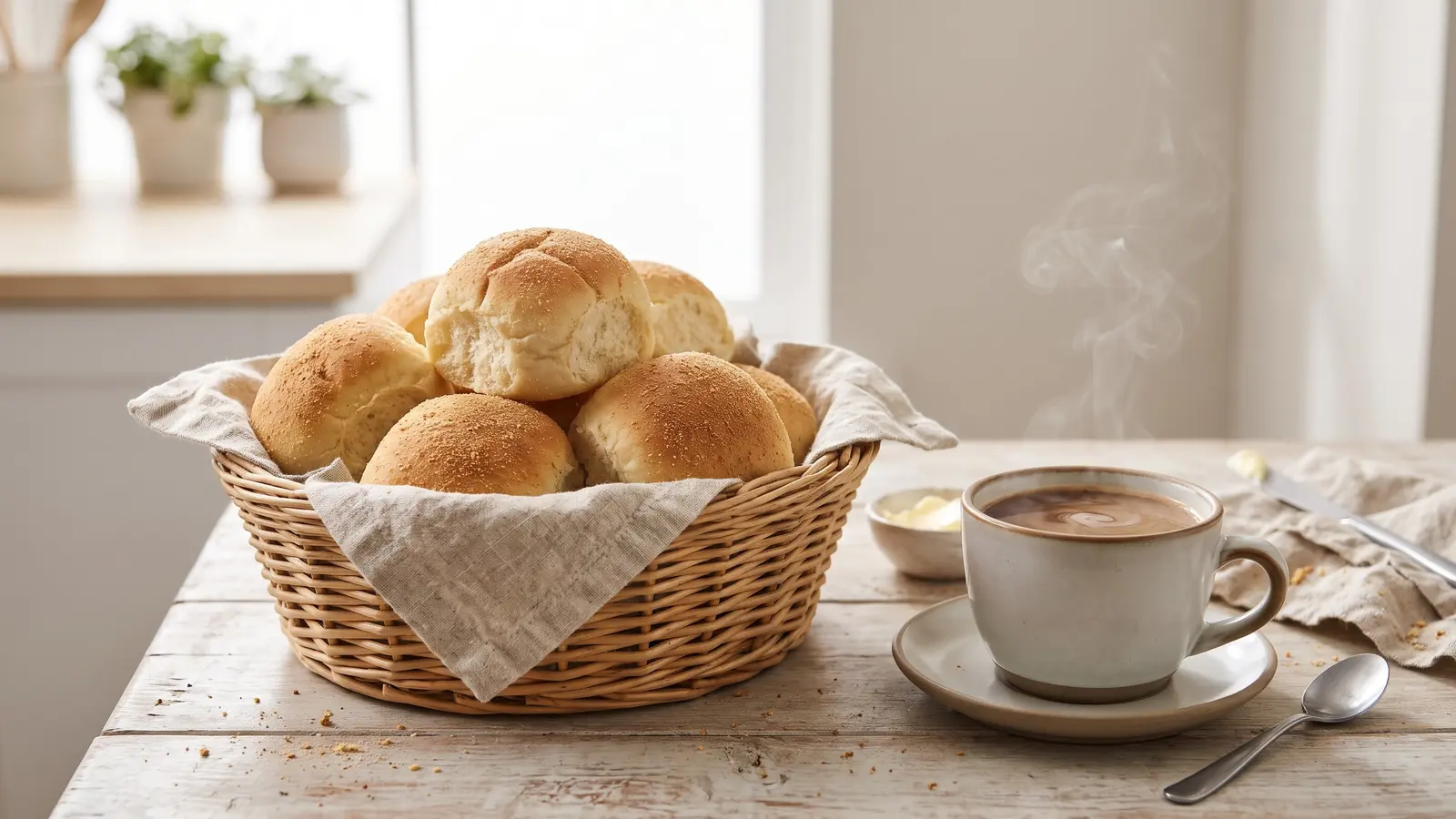
Pandesal is the everyday roll, and monay and putok are two other common rolls with different textures. Pandesal is light and soft, with a breadcrumb coating, and is eaten at breakfast and merienda. Monay is denser and firmer, with a distinctive split along the top, and is often described as a more filling bread. Putok means burst or crack in Tagalog, and the bread is named for the cracked, sugary top.
Because these are plain or lightly sweet, they are used as table breads and for sandwiches. Pandesal and monay are often split and filled with butter, cheese, eggs or cold cuts.
Nanding’s Bakery is reported to sell pandesal and, according to the Honolulu Star-Advertiser, it is the second best seller after the Spanish rolls. It appears on its menu as recorded in November 2026 as Pan de sal. A 2007 Honolulu Advertiser profile recorded a price of 25 cents each, which is an old price, and no current price was found.
What are the sweet filled breads?
Spanish bread, pan de coco, mongo loaf and ube loaf are the sweet filled breads of the shelf. Each one has a sweet center or a sweet dough and is usually eaten as a snack.
Spanish bread is rolled around a butter, sugar and breadcrumb filling, so the center is sticky and sweet. Pan de coco is a soft bun filled with sweetened grated coconut. Mongo loaf is filled with a paste made from mung beans, and is known as mongo in Filipino and Hawaii English because of the Filipino word for mung bean, monggo. Ube loaf and ube rolls use the purple yam for flavor and color.
On the menu of Nanding’s Bakery as recorded in November 2026, the sweet breads include Spanish rolls, Ube Spanish roll, Ube bread, Guava loaf, Mongo loaf and Balintawak bread. The Guava loaf was tried by a 2017 blogger, who described it as soft and lightly sweet. The Mongo loaf was listed at $2.50 in 2007, and current availability is unknown. Balintawak bread is described as a red-tinted, cakey bread pudding wrapped in sweet bread, priced at 95 cents in 2018.
What are the savory rolls?
Savory rolls are soft breads wrapped around meat or cheese, and they are popular in Filipino bakeries in Hawaii. They are not found in every Philippine panaderia, but they are a well-known part of the Hawaii Filipino bakery scene.
| Savory roll | Filling |
|---|---|
| Cheeseburger roll | New in late August 2018, may no longer be sold |
The cheeseburger roll is on the menu of Nanding’s Bakery as recorded in November 2026. It has no price in the sources, and it may no longer be sold. No current price was found, so call (808) 367-1172 for today’s range.
Why are Filipino breads soft and sweet?
Filipino breads are soft and sweet mainly because their doughs are enriched with sugar, milk and fat, and because many are made for snacks and merienda. A dough with sugar, milk and butter or oil bakes into a tender, fluffy crumb that stays soft longer than a lean dough.
Sources do not agree on a single reason for the sweetness, and any single explanation should be treated as a theory. Some writers point to the influence of Spanish and American baking, some to local taste for sweet snacks, and some to the use of sugar and coconut in Philippine cooking. This guide has not found a primary source that settles it, so the cause is best described as unconfirmed.
What is clear is that the style is consistent across much of the panaderia shelf. Even savory rolls are usually made with a soft, lightly sweet dough, which is part of what makes a Filipino bakery taste different from a French or German one.
How do you buy Filipino bread?
Filipino bread is usually bought at the counter, by the piece, the bag or the box. Small breads such as pandesal are often sold in bags, and larger items such as loaves and pastries are sold individually or in boxes.
A few practical points:
- Go early for warm bread, since many panaderias bake in the morning.
- Ask what is freshest, because stock changes through the day.
- Buy extra to freeze, since most soft breads keep well in the freezer.
- Call ahead for large orders. A 2018 Star-Advertiser column advised calling a day ahead at Nanding’s Bakery.
- Ask about ingredients if there is an allergy, since the sources used here do not list ingredients.
The Martha Street shop of Nanding’s Bakery is listed on Google Maps as open from 6 AM, with a 1 PM close on Monday and a 5 PM close from Tuesday to Sunday, read on November 11, 2026. The Gulick Avenue shop is listed open daily from 4:30 AM to 6 PM. See hours and location and the locations page for details.
How should you store Filipino bread?
Most Filipino bread is best the day it is baked and should be stored in a bag or box at room temperature for a day, then frozen. Soft, enriched breads dry out quickly when left uncovered.
| Bread type | Best storage | Reheating |
|---|---|---|
| Pandesal, monay, putok | Bag at room temperature, freezer for longer | Toaster oven or oven |
| Spanish bread and filled rolls | Bag or box, freezer for longer | Short warm-up to soften the filling |
| Ensaymada | Box at room temperature, cool spot in heat | Briefly warm, avoid long microwaving |
| Savory rolls | Refrigerate if the filling contains meat or cheese and the roll will not be eaten soon | Oven or toaster oven until hot throughout |
For savory rolls with meat fillings, food safety matters, so keep them cold if they will not be eaten the same day and heat them until hot throughout. These are general home-kitchen guidelines and not instructions from any bakery.
What are common mistakes when trying Filipino bread for the first time?
The most common mistakes are buying only one item, eating cold bread and expecting every roll to taste alike. Many first-timers assume that all Filipino breads are the same, but a plain pandesal and a filled ube roll are very different.
- Start with the best sellers, such as Spanish rolls and pan de sal, to learn the basic style.
- Try one savory roll and one sweet roll to see the range.
- Warm the bread before eating if it has cooled.
- Avoid assuming that a menu item is available, since stock changes.
The menu page lists the items recorded for Nanding’s Bakery with the dates of the sources. It is a good starting point, but confirming with the shop is the safest approach.
Common questions
What is a panaderia?
Panaderia is the Spanish-derived Filipino word for a bakery. It usually means a neighborhood shop that sells bread, rolls and pastries by the piece or the bag.
Why is Filipino bread sweet?
Many Filipino breads use sugar, milk and fat in the dough, so they taste soft and mildly sweet. Taste preferences and recipe habits play a role, and sources do not agree on one single reason.
What is the most common Filipino bread?
Pandesal is usually named as the everyday bread. It is a small, soft roll with a breadcrumb coating that is eaten at breakfast and merienda.
What is monay?
Monay is a dense, slightly sweet roll with a distinctive split or ridge along the top. It is firmer than pandesal.
Are Filipino breads the same everywhere in the Philippines?
No. Names, shapes and fillings vary by region and by bakery, so the same word can refer to slightly different breads in different places.
Planning a visit? Start with Nanding's Bakery Honolulu: address, opening hours, menu and directions in one place.
This article is general information from an independent guide, not from Nanding's Bakery itself. For the store’s current details see hours and location.